Election insights: Making sense of Senedd Election polling
Grasshopper Communications’ Dr Andy Cotter-Roberts and Craig Lawton take a look at the Senedd election polling and what it could mean once the votes are counted
As this year’s Senedd election gets closer, we are seeing more and more opinion polling being carried out.
Each of these polls paints a different picture of what the outcome could be, and which parties could be vying for power.
How do we therefore make sense of these polls, what can we learn from them, and how are they all giving different information?
What is the Grasshopper polling model?
At Grasshopper, we have brought together our Research & Insight team and our Corporate Affairs team to answer these questions and to bring some clarity.
Instead of carrying out yet more polling, we aggregate all the e polling data available. Then, through Monte Carlo simulations, we run thousands of projections to help us understand the range of different potential outcomes and how they result in seats across the 16 new Senedd constituencies.
As each set of new polling data is released, we can include it in our model. The more data we include, the more robust our results.
What does the Grasshopper model tell us?
Over the past year, 18 opinion polls have been carried out.
Combining all this data, the Grasshopper model can now show how the proposed vote share is translated into seats across each of the 16 Senedd constituencies.
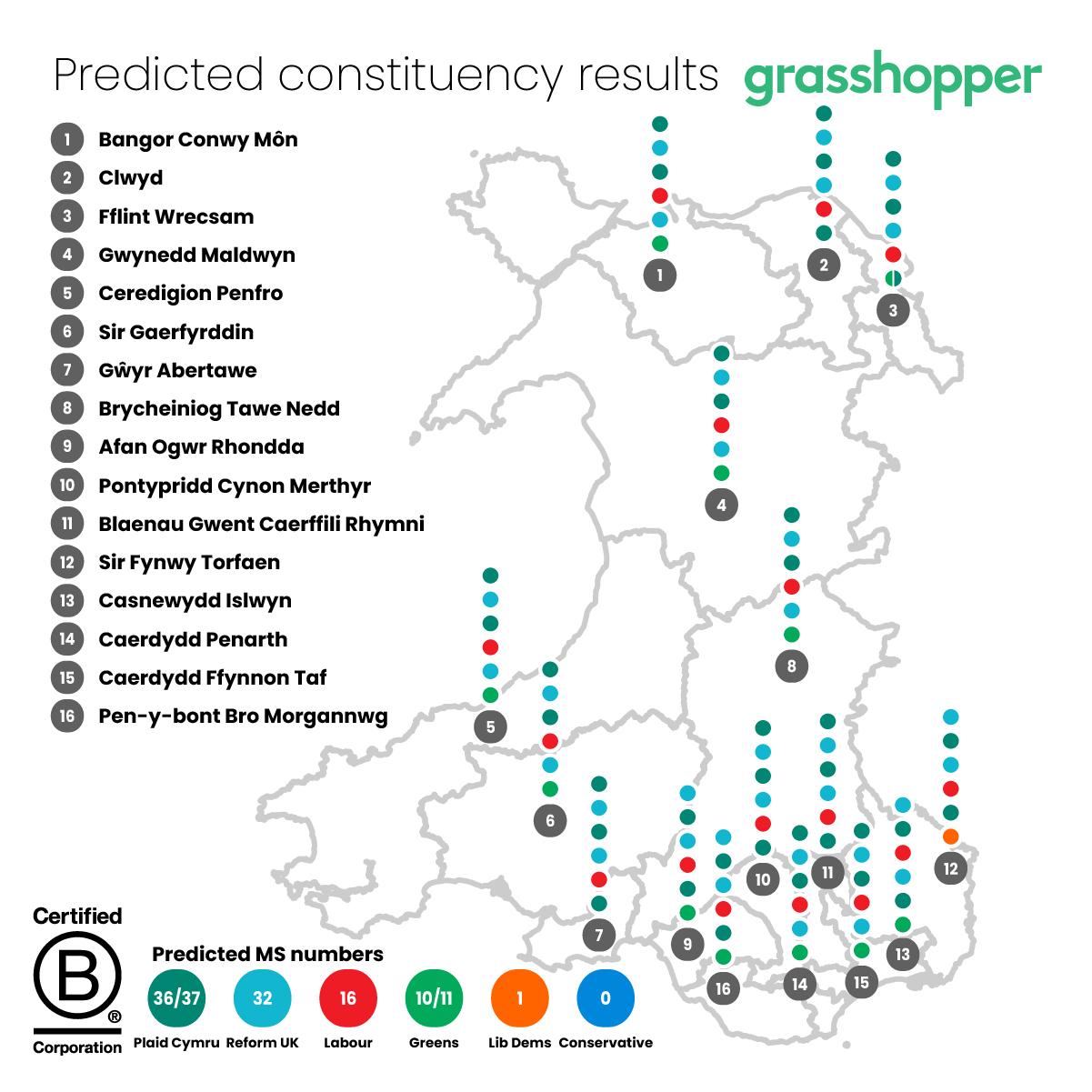
What does the polling tell us?
The latest polling data suggests there has been a shift since the start of the year.
Plaid Cymru held a commanding lead in January 2026. This saw them polling as high as 37% in some surveys. However, the party’s support has fallen back. They now sit around 30%.
In comparison, Reform UK has surged from around 20% to just short of 30%. The party has also remained consistently competitive across multiple pollsters.
Polling data suggests that Labour’s position is less stable. After recovering from a low base in January, the party’s support has fluctuated between around 15% and 25%. This sees the party competing more directly with both Reform and the Greens in key contests.
Multiple polls suggest that the Greens will be a force in the Senedd after the election, whilst these same polls suggest both the Lib Dems and Conservatives face near wipe-out.
Taken together, these trends point to an increasingly fragmented electoral landscape, with three or more parties clustered within a relatively narrow vote share range.
This could well result in small changes in vote share determining the outcome in a handful of decisive contests across Wales.
What does this mean for the Senedd election result?
This suggests that:
• No party is close to a majority, with a small number of seats likely to decide the overall outcome
• Plaid Cymru remains ahead in most polls, but its lead has narrowed significantly since January
• Reform UK has stabilised, emerging as a credible contender to top the poll
• Labour’s support remains volatile, with no clear hold on third place
• The Greens are consistently competitive, particularly in contests for the sixth MS across multiple seats
Where will the key battlegrounds be?
Grasshopper's modelling has been suggesting there will be a number of constituencies where the final seat remains too close to call.
The result of who wins the sixth MS in these constituencies could have a significant impact on the final make-up of the Senedd after the election. Some of these contests are likely to be decided by extremely narrow margins.
When carried out with less polling data, the Greens were fighting against Labour in Clwyd, Gŵyr Abertawe, and Pontypridd Cynon Merthyr for the sixth MS, whilst they were also fighting the Lib Dems for the sixth MS in Sir Fynwy Torfaen.
Since more polling has been added to the Grasshopper model, we are now seeing just one close fight for the sixth MS. This is now between Plaid Cymru and the Greens in Fflint Wrecsam.
Whilst national polling gives us an overall indication of likely results, battles for the sixth MS in constituencies could still be decided by a combination of good local campaigns and whichever party has the best ‘get out the vote’ strategy on polling day itself.
Therefore, whilst the new Senedd electoral system arguably encourages wide-reaching national messages instead of individual candidate messages and campaigns, the local campaigns could still make all the difference.
These contests could ultimately determine whether:
• Reform UK emerge as the largest party in the Senedd
• Plaid Cymru can secure enough MSs to govern without a coalition or agreement with other parties
• Labour or the Greens hold the balance of power in any potential deal
As previous modelling by Grasshopper has shown, even small changes in vote share in these seats can have a disproportionate impact on the overall result.
How does Grasshopper’s model work?
Grasshopper's model combines all available Senedd polling into a single, consistent view of the race, and then estimates how these vote shares could translate into seats.
Rather than relying on any one poll, we aggregate across pollsters to reduce noise and identify underlying trends. We then simulate thousands of possible election outcomes using a Monte Carlo approach, varying vote shares within realistic bounds to reflect uncertainty in the data.
This allows us to move beyond a single “headline projection” and instead, understand the range of possible outcomes - including which results are most likely, and which remain plausible. These results should be seen as probabilistic estimates- not predictions.
Why this matters
Under the Senedd’s electoral system, how votes are distributed is as important as the headline vote share.
Reform UK’s relatively even support across Wales puts it in a strong position to convert votes efficiently into seats. By contrast, Plaid Cymru’s more concentrated support means it risks diminishing returns in areas where it is already dominant.
Meanwhile, Labour and the Greens are increasingly competing for the same pool of seats - particularly the final seats in each constituency, where margins are tight and outcomes highly sensitive to small shifts in vote share.
Looking ahead
Grasshopper will continue to update its model as new polling is released in the run-up to polling day.
Dr Andy Cotter-Roberts is Grasshopper’s Head of Research and Insight
Craig Lawton is Grasshopper’s Head of Corporate Affairs